Increasing your reading speed is possible
If you ask me what surprised me the most during my speed reading practice, my answer would be this:
I used to think speed reading meant skimming, and I was completely wrong. The book I’m So Smart, You Are Too completely changed the way I read.
In fact, speed reading is about reading correctly, not reading less.
Read by keywords
Everything started with a very “real-life” realization:
In any text, only about 20% is core content; the remaining 80% consists of linking words, filler words, and words that smooth out sentences such as and, if, then, is, but…
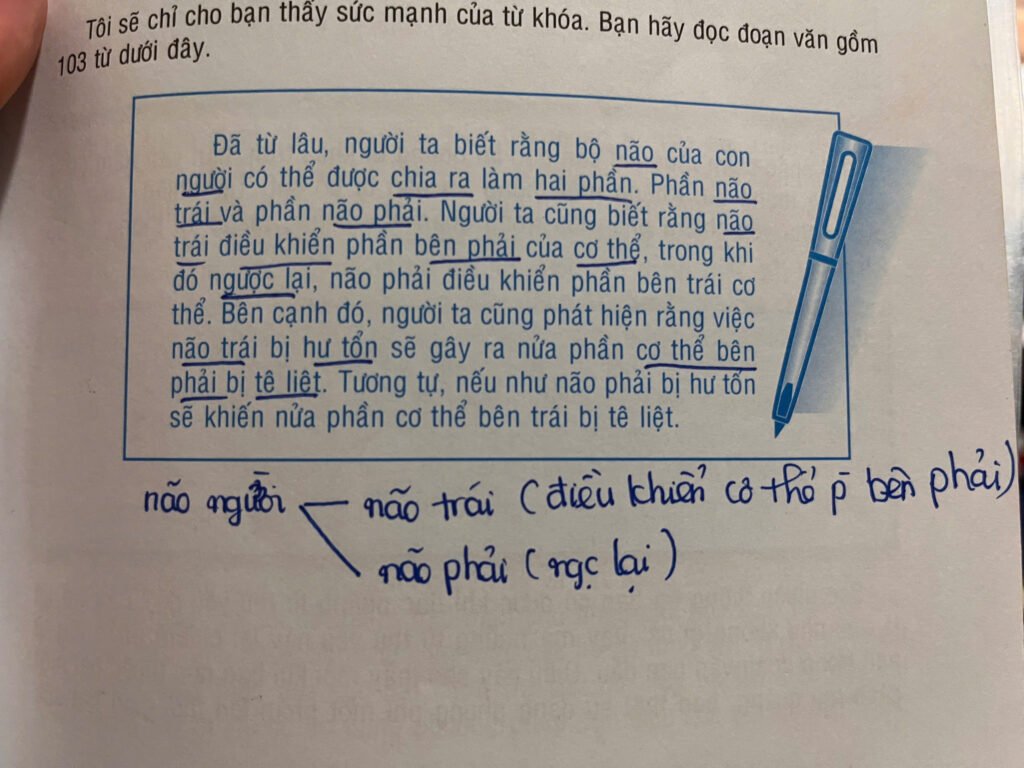
An example from the book I’m So Smart, You Are Too about keywords in a paragraph. When you look at such a long passage, it feels like there’s a lot to read, but when we summarize the information, the actual content is surprisingly small.
That means I was spending 100% of my time reading what my brain only needed 20% of.
Expand your visual span
Besides that, the key to speed reading is expanding your visual span. An average reader reads word by word—each glance captures just one word. With speed reading, however, one glance can capture 3–5 words at a time. I’ll explain this more clearly in the section below.
And of course, practice is non-negotiable.
From 150 words per minute to 700 words per minute: an unexpected one-week journey
Trước khi luyện, tốc độ đọc của mình rơi vào khoảng 150 từ/phút đọc chậm, đọc kỹ, nhưng rất dễ mệt và… buồn ngủ.
I started practicing eye exercises seriously for one week, and the result was that my visual speed increased by 2.5 times.
After that, I maintained the habit of speed reading and reached about 700 words per minute.
To test it, I chose to read stories by Nguyễn Nhật Ánh (since I had read many of them before).
The books have spacious text, gentle writing, and a clear storyline—perfect for practice. And if you don’t understand what you’re reading, you simply can’t continue the story, which makes it ideal for testing both eye speed and brain comprehension.
I finished a 100-page story in about 40 minutes, while still following the plot and staying emotionally connected to the characters.
That’s when I knew: okay, I did it.
Fast reading helps you stay more focused
Sounds strange, right?
But it’s genuinely true.
When you read slowly, your brain has a lot of empty space to wander:
you can read while thinking about what happened yesterday.
When you read fast, your brain stays busy—like when you’re riding a motorbike at high speed:
==> you’re forced to focus, with no time to drift off.
That’s why speed reading doesn’t make you superficial; it actually makes you more alert.
Test your reading speed
The way I measure it is very simple:
- Choose any passage
- Start a 60-second timer
- Count the number of words you read
That number becomes your baseline to track progress—and trust me, you’ll be surprised.
Habits that slow down your reading speed
I used to have all of them. So if you see yourself here, don’t worry.
Lip reading
The problem:
Lips move → the brain is pulled back to speaking speed → reading can’t be faster than speech.
How to fix it:
Hold a pen in your mouth or chew gum while reading. It sounds funny, but it really works because it breaks the old habit. You just need to get used to not moving your lips.
Having a voice reading silently in your head
The problem:
You’re “hearing” the words instead of “seeing” them, so your speed is limited.
How to fix it:
Use a pen or your finger to guide the line slightly faster than your reading speed. Your brain will be forced to keep up.
Re-reading
The problem:
Your brain doesn’t trust that it has understood, so it goes back to check—and that’s what slows you down.
How to fix it:
Self-reminder: you’re reading to understand the idea, not to memorize every single word.
If needed, only go back to the end of the chapter, not to each line.
Reading word by word
The problem:
This habit comes from when we first learned to read, but it’s the number one enemy of speed reading.
How to fix it:
Practice seeing groups of 3–5 words at a time. It will feel tiring at first, but your eyes adapt very quickly.
Narrow visual span
The problem:
Your eyes can only catch 1–2 words → more eye movements → slower speed.
How to fix it:
Practice seeing an entire short line, or half a line at once.
You can also use visual span expansion exercises on YouTube (5–10 minutes a day is enough).
Effective practice methods
✍️ Use a pen as a guide
This method is old-school, but it works. Your eyes move faster than your hand, so your speed naturally increases. When reading, train yourself to take in 3–5 words at a glance, then gradually increase. The guide should point to groups of words, not individual ones.
🔑 Find keywords, skip filler words
Each paragraph has only a few keywords. Once you spot them, you understand the whole paragraph.
👀 Expand your visual span
Practice reading in chunks, not word by word.
📘 Read the summary first
Reading the end-of-chapter summary first helps your brain know what to look for → much faster reading.
⏳ Practice consistently
I practiced eye exercises for one week, then continued speed reading with novels I enjoy to make sure of one thing: reading faster while still understanding.
I chose Nguyễn Nhật Ánh’s stories because:
- If you read fast without understanding → you’ll know immediately
- When you don’t understand, the storyline breaks right away
- Books that are too difficult at the beginning will only discourage you. Don’t make it harder than it needs to be.
You can also practice with speed-reading videos on YouTube or with reading speed training apps like WPM.Ninja.
After a period of practice, I realized something very simple: speed reading helps you save time and reserve your energy for books that truly deserve to be read slowly. And reading becomes more enjoyable than ever.
Conclusion
In short, increasing your reading speed is a skill that can be fully trained if you have the right method and enough persistence. Through my real experience of reading and applying ideas from I’m So Smart, You Are Too, I found that the book goes beyond speed reading—it opens up many interesting perspectives on thinking, learning, and working more effectively.
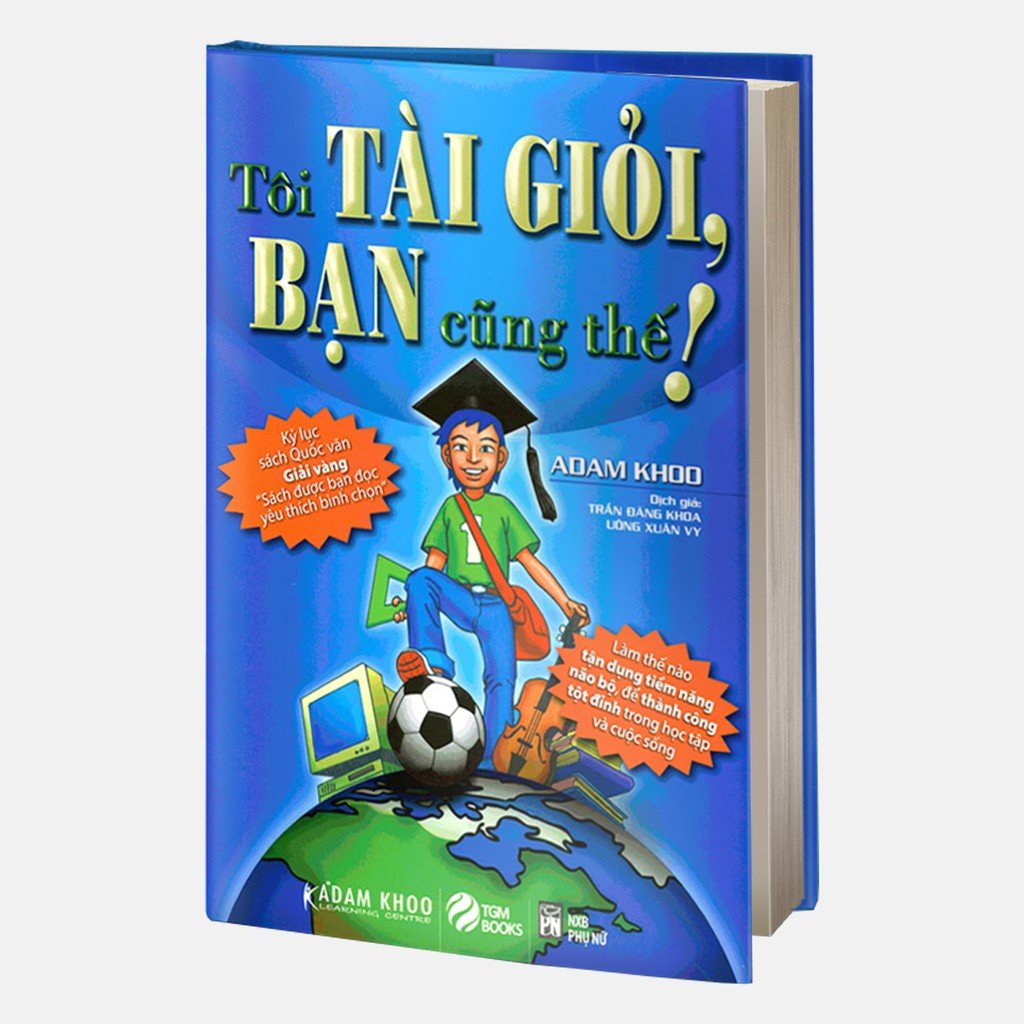
The knowledge in this book is especially suitable for students, helping them study more easily, understand more deeply, and become more proactive in their learning journey. If you’re looking to level yourself up starting from the most foundational habits, this is a book truly worth reading and putting into practice.
Linkachu — someone who battled weight issues for nearly 20 years and successfully experimented with a method of eating fully and nutritiously while still losing weight, without exercising.
Ready to accompany and support career orientation and development positioning for people aged 18–33..
This is my Facebook! LinkachuMC
Learn more about me at Linkachu.net



 English
  Vietnamese