The root of suffering
There was a girl whose father loved her more than anyone else in the world.
From the day she was born, she was a treasure in his eyes. He loved her, protected her, and patiently taught her little by little. She kept those memories of care deep in her heart. To her, her father was both a gentle, honorable man and the strongest, bravest support in her life.
On the day she graduated, her father arrived very early. During the ceremony, when he saw his daughter walk up to receive her diploma, his eyes filled with tears of pride. On the day she got married, at the wedding, he held the groom’s hand and said in a low, trembling voice: Please take good care of my daughter. Don’t let her cry. Don’t let her come back to me in pain.
Not long after that, her father passed away because of a serious illness.
The pain came so suddenly that she lost her sense of direction. For many months, she barely ate, became very thin, stopped working, and had no energy to do anything. Every day, she just lay there, living in memories of the two of them, as if holding tightly to those memories could keep her father close.
Before he passed away, her father did not leave her many things. There was only one watch—a gift he had carefully saved up to buy for her because he thought it suited her. She did not wear it often, but she cherished it as the most precious thing in her life. After her father’s death, it became even more valuable. She often kept it in her bag, as if carrying the watch meant carrying her father’s presence with her.
One day, on her way home, her bag was snatched.
In that moment, she started shaking. It felt as if her whole world had collapsed. There were many important documents and valuable items in the bag, but she no longer cared about any of them. The only thought in her mind was: her father’s watch was gone.
In the past, she had once lost a watch worth tens of millions. At that time, she felt some regret over the money, and then it passed. But this time, even though the watch was only worth a few hundred thousand, the pain was so overwhelming that it took her breath away—as if she had lost her father one more time.
At first glance, the girl’s pain seemed to come from losing a watch.
But in truth, the pain did not come from the watch itself. It came from the deep love she had for her father.
The watch held special meaning for her because it was a gift her father left behind. She clung to it as a way to soothe her longing, as proof that her father was still present beside her. When the watch was lost, that emotional support collapsed as well. The pain was no longer about losing an object, but about feeling as if she had lost her father once again.
It was this attachment that caused the suffering to arise—deep and intense, equal to the pain she felt on the day she said goodbye to her father forever.
The tree model of suffering
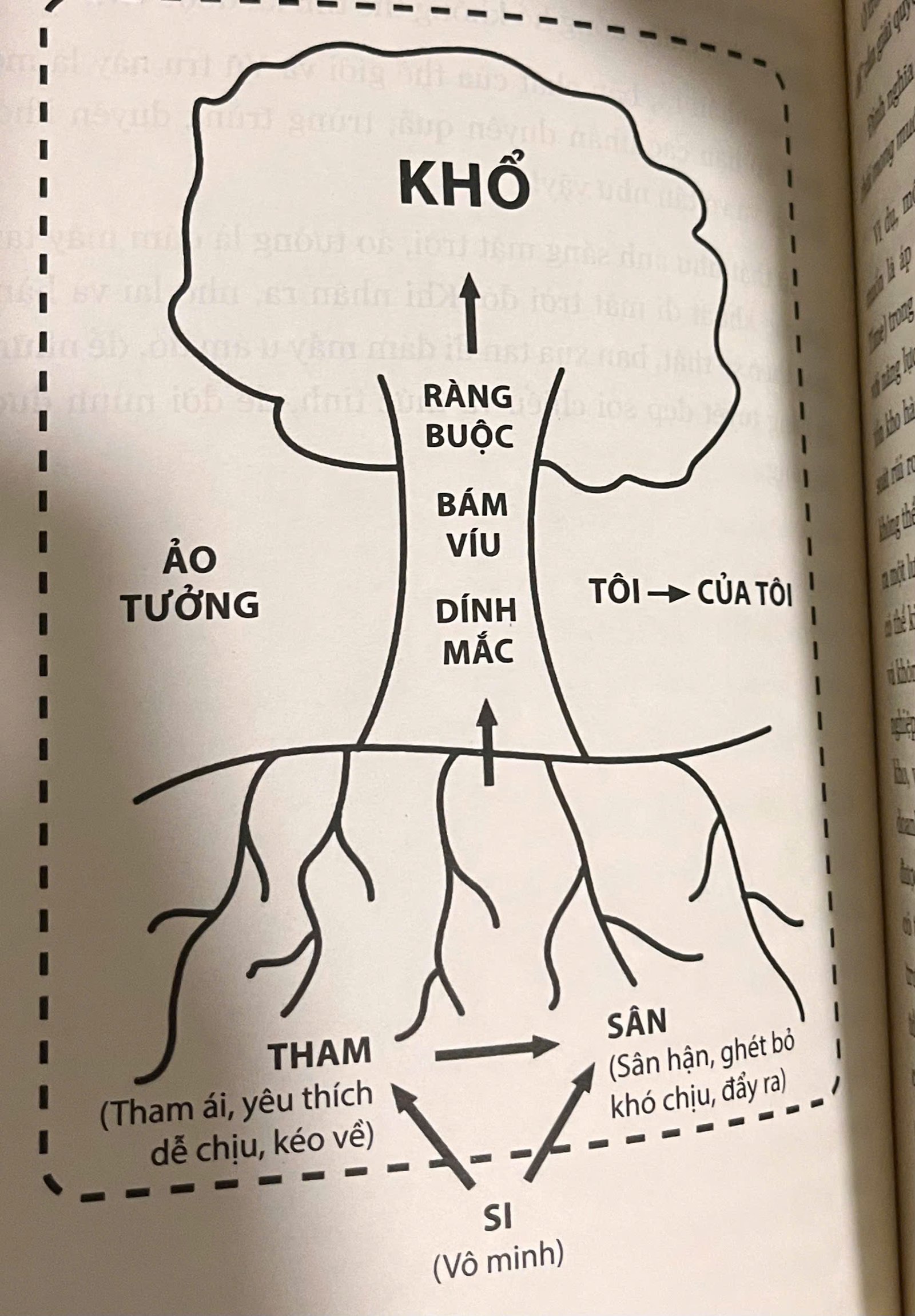
From this tree diagram, we can see that clinging, attachment, and emotional bondage are the causes of suffering. And they also have their own roots. The roots of the tree are what nourish and sustain all suffering.
The roots of suffering: Greed – Anger – Ignorance
Greed (craving, clinging)
The girl was not only sad because she lost an object, but because she wanted to keep that keepsake forever, to hold on to the feeling that her father was still by her side.
Her love for her father was something truly beautiful. But when she could not accept the impermanence—that her father could not stay with her for her whole life—that love gradually lost its clarity (ignorance). She wanted her father to remain with her forever, regardless of the law of birth, aging, illness, and death that no one can escape.
At this point, love transformed into craving.
Craving was not born from selfishness, but from clinging.
And when people try to hold on to something that cannot be held, suffering is inevitable.
Anger (hatred, resentment)
From her craving toward her father and the watch, when the watch was lost, she did not feel only sadness but also anger. From that very clinging, the mind of anger began to arise.
At the moment her bag was snatched away, she fell into a state of:
- shock
- trembling
- feeling as if the world had collapsed
But this anger was not only anger toward the thief or frustration over losing her belongings. The anger here was deeper: it was resistance to reality. It was the feeling of not accepting what was happening, the question that arose in her mind:
“Why did this happen to me?”
When reality does not unfold according to our wishes, anger arises, and suffering spreads with it.
Ignorance (not seeing the truth)
Here, ignorance does not mean being unintelligent or uneducated.
It simply means not understanding the true nature of things, not seeing the natural laws of life.
Ignorance is the deepest root of suffering.
Because she could not see clearly, the girl misunderstood: she believed that the watch represented her father himself. So when the watch was lost, she felt as if her father had left her once again.
But the truth is very simple:
- The watch is just an object.
- Love and memories of her father do not exist inside that object.
She suffered because she did not understand that everything is impermanent—everything comes and goes in its own time. No one can stay with us forever, no matter how deeply we love them.
This “not knowing” prevented her from seeing the truth clearly. She attached her longing and emotions to an external object. And when that object was lost, the suffering inside her erupted—deep and intense.
Illusions give rise to ignorance
Illusion is like a layer of fog that covers the truth. The truth is still there, but because it is obscured, we can no longer see it clearly.
The girl’s illusion was the belief that:
“The watch could preserve her father’s image, keep the love, and hold on to the feeling that her father was still with her.”
Because she believed this, when the watch was lost, she did not only lose an object—she felt as if her emotions, memories, and attachment were taken away as well.
“I” and “Mine”: the strongest fertilizer of suffering
“My father’s watch.”
“My keepsake.”
“My pain.”
Just by adding the word “my,” everything immediately begins to operate in a different way. And because of that, suffering takes root even more deeply.
If the lost watch had belonged to a stranger, the girl would not have suffered like this. If the watch had not been connected to her father, the pain would not have been so intense. In the same way, when we see someone else lose something, we may feel sympathy, but we do not feel the same sadness or anger as when we lose something ourselves.
Truth: the axe that cuts down the tree of suffering
Truth is like sunlight. When it appears, the fog of illusion naturally fades away. There is no need to chase it away or fight it—where there is light, darkness has no place to remain.
When people see the truth clearly, ignorance (misunderstanding, not knowing) gradually dissolves. And when ignorance is gone, suffering no longer has roots to cling to. Suffering does not disappear because we force ourselves to forget, but because we have understood.
When the girl came to understand this, she still remembered her father and still loved him. But now, the memories of her father brought warmth and peace, not pain. She felt happy when thinking of him, because she knew that love does not disappear—it simply no longer exists in its old form.
understood that everything is impermanent.
understood that love does not exist in possession.
understood that nothing belongs to us forever.
From this understanding, people awaken—not to become cold or detached, but to live more lightly, to love more fully, and to be happier within their own lives.
Conclusion
The content above is my reflection and reinterpretation inspired by the book Right Livelihood (Khởi Chánh Nghiệp).This book looks at life and business through a Buddhist perspective.
It is not a book to read just to “gain more knowledge,” but a book to help you understand yourself betterunderstand why you suffer, and how to reduce suffering in a lasting way. If you are struggling with your emotions, dealing with loss, or simply want to live more lightly, I truly recommend reading Khởi Chánh Nghiệp at least once. Right Livelihood (Khởi Chánh Nghiệp). một lần.
I will continue sharing meaningful, easy-to-understand insights drawn from Khởi Chánh Nghiệp and many other valuable books. Right Livelihood (Khởi Chánh Nghiệp). và nhiều cuốn sách giá trị khác.
If you are interested in the journey of self-understanding, living with awareness, and becoming happier, follow me so we can read together, reflect together, and grow a little every day.
—————
Linkachu — someone who battled weight issues for nearly 20 years and successfully experimented with a method of eating fully and nutritiously while still losing weight, without exercising.
Ready to accompany and support career orientation and development positioning for people aged 18–33..
This is my Facebook! LinkachuMC
Learn more about me at Linkachu.net

 English
  Vietnamese