There are books people read once and then place back on the shelf. But there are also books that never really “end.” They simply stay there, in a very familiar corner of our lives. For me, Totto-chan by the Window by Tetsuko Kuroyanagi is one of those books.
It sits by my bedside. Not because I need to read it every day. But because I know that there will be moments when I will want to open it again.
Moments when my heart feels a little noisy.
Moments when life starts moving too fast.
Moments when I just want to find something simple again: a sense of peace..
But the more I read it, the more I realize that this book does not only bring me peace. It also makes us think deeply about children and the way adults treat them.
Brief introduction to the book
Totto-chan by the Window is a collection of childhood memories by Tetsuko Kuroyanagi. It is written in a very gentle voice, yet it contains many reflections on education and the way adults view children. It is an easy book to read, easy to understand, and easy to empathize with the author. Totto-chan’s story does not stop on the pages of the book. The work has also been adapted into a theatrical animated film titled Totto-chan: The Little Girl at the.
The main character is a little girl named Totto-chan, a child who is extremely curious, energetic, and somewhat “different.” She asks many questions, loves exploring everything around her, and always acts according to her interests. However, that very difference makes Totto-chan seen as a “difficult” student. Eventually, she is expelled from her first elementary school at a very young age.
After that, her mother takes Totto-chan to a very special school called Tomoe School.
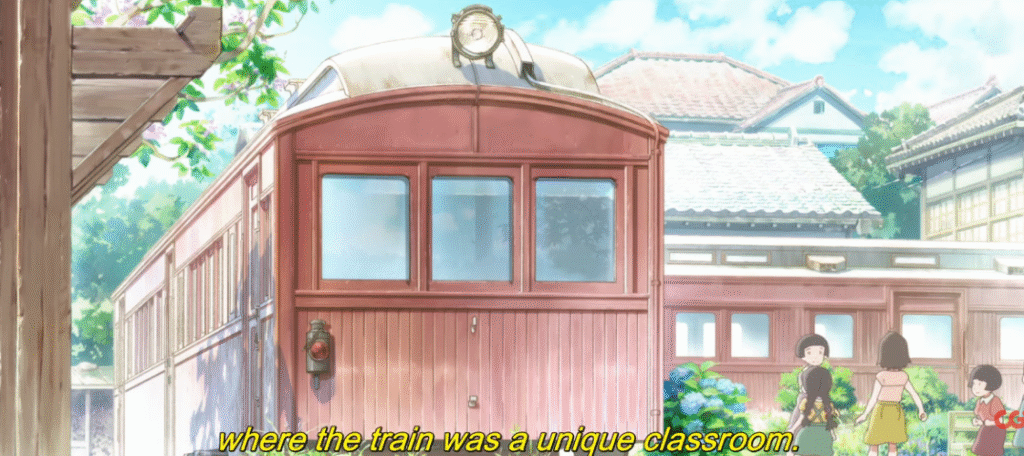
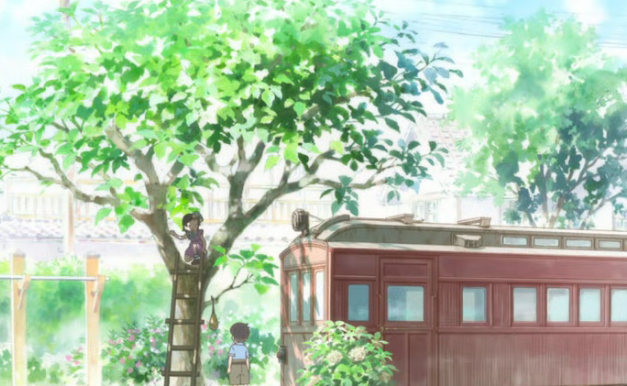
There, classrooms were not the familiar rooms but old train carriages. Students could choose their subjects for the day, learn in nature, ask questions, and explore the world in their own way. The school had a very special educational approach that made me reflect a lot on how I communicate and interact with children.
Sometimes I think, if Totto-chan had only been seen as a “troublesome” child back then, if she had continued to stay in an environment that constantly judged and suppressed differences, perhaps the author’s life would have taken a completely different path.
If there had not been a mother patient enough to believe in her child, and if there had not been a school open-minded enough to understand children, perhaps that child would have grown up carrying many wounds.
The emotions the book brings to readers
The cuteness in small stories
One very special thing about Totto-chan by the Window is that the book does not need dramatic plots to make readers remember it. Instead, it is built from very small, everyday stories that make people smile naturally.
Sometimes it is simply the image of little Totto-chan standing and talking endlessly with the train ticket seller because she is so curious about their job. In the eyes of adults, that might look like a child who talks too much. But when reading that story, we instead see a child excitedly exploring the world around her.
Or the lunches at Tomoe School, where the principal always reminded students to bring “a little from the sea and a little from the mountains.” Just a simple sentence, yet it made children’s meals much more interesting. It was not a dry rule about nutrition, but a gentle way to help children understand that their meals should be balanced.
Small details like these appear throughout the book. They are not grand or preachy, yet they make the story warm and full of life.
Reading those pages, sometimes you do not even realize when you started smiling.
The sense of peace while reading
Perhaps one of the reasons this book has become a “bedside book” for many people is because it brings a very rare feeling: peace.
The book does not contain major events, tense climaxes, or dramatic moments that keep readers on edge. It is simply a collection of childhood memories told through a gentle and sincere voice.
Yet it is exactly this simplicity that makes the reading experience so comforting.
When reading, I often feel as if I am seeing the world through a child’s eyes. Everything feels worth being curious about: a train ride, a field, a lunch, or even a long conversation with an adult.
The world in the book is not rushed or noisy. It is slow, gentle, and filled with small things that are worth appreciating.
Perhaps that is why, every time I open a few pages of this book again, I feel my mind slow down a little and become lighter—as if I have just stepped into a very clear and innocent corner of childhood.
Lessons and perspectives about children
After the small, charming stories and the peaceful feeling while reading, what truly stays in my mind for a long time about Totto-chan by the Window is its perspectives on children. The book does not try to lecture readers with moral lessons, but through each story, it quietly makes us ask ourselves: have we truly understood children?
Lesson 1: Children are not “troublesome”, they are simply curious
At her first school, Totto-chan was seen as a mischievous and difficult student. She kept opening and closing the lid of her desk, stood by the window talking to people outside, and often did things that teachers found hard to control.
But when reading that story, I saw something different: Totto-chan was simply curious about the world around her.
She wanted to know how the desk worked.
She wanted to talk to people passing by because she found them interesting.
She asked questions because she genuinely wanted to understand things.
To adults, these actions might be labeled as “troublesome.” But in reality, they are just very natural expressions of a child exploring the world.
The book made me realize that sometimes adults are too quick to label children instead of trying to understand what is happening inside their small world.
Lesson 2: Listening to children is more important than we think
One of the most famous moments in the book is the first time Totto-chan meets the headmaster of Tomoe School.
During that meeting, she talks nonstop for hours. The stories are small and random—simply whatever comes to her mind.
The headmaster just sits there and patiently listens.
He does not interrupt.
He does not show impatience.
He does not judge.
He simply listens.
Reading that part, I suddenly realized how rare that is. Adults often teach children how to speak properly and behave properly, yet they rarely take the time to truly listen to them.
It reminded me of when I was little and wanted to tell my mother something interesting. She was busy doing other things and talking to someone else, and I kept calling, “Mom, Mom,” again and again. Then she scolded me, saying, “Can’t you see I’m talking?” At that time, I did not know that I should wait for others to finish speaking before talking. I only wanted to share my story. The feeling of disappointment at that moment was immense.
Lesson 3: Every child develops at their own pace
At Tomoe School, students were not forced to study in the same way or develop according to a fixed pattern.
They could start the school day with the subject they liked.
They learned through experiences, through nature, and through practical activities.
Classes could take place in a field, in the forest, or anywhere that sparked children’s interest.
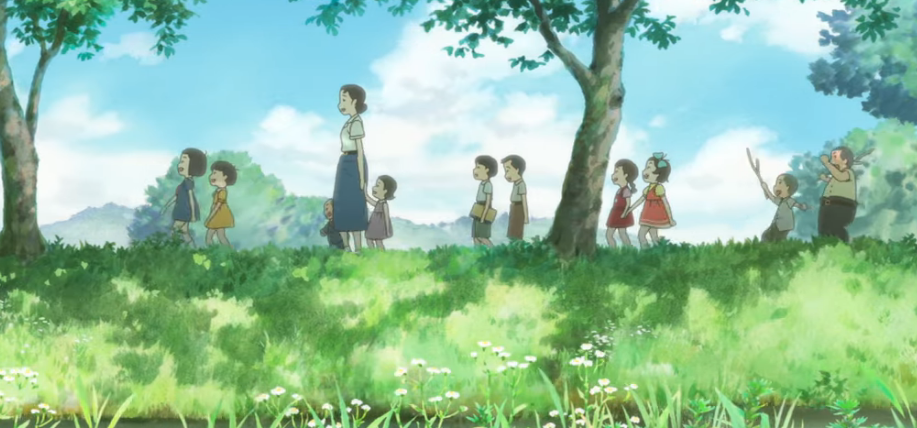
That approach to education made me think that education should not simply be about delivering as much knowledge as possible. What matters more is helping children keep their curiosity and their joy of learning.
Because every child has their own pace of development and their own way of exploring the world.
Lesson 4: Good education begins with respecting children
The headmaster of Tomoe School had a belief that was very simple, yet very powerful:
“Every child is a good child.”
At first, that sentence sounds simple, but it completely changes the way adults look at children.
When we believe that a child is inherently good, adults will not rush to punish or judge them. Instead, they will try to understand the reason behind the child’s behavior.
Perhaps that is also why Totto-chan—who was once considered a “difficult” child was able to grow up in an environment filled with confidence and joy.
There is also a small story about the time Totto-chan dropped her wallet into the septic tank and dug everything up to find it. When I read that part, I thought that if it were me—or anyone else—seeing a child digging in the septic tank with pieces of poop scattered everywhere, we would probably go crazy. But the headmaster came and spoke as if he were chatting with a friend: “What are you doing, Totto-chan?” After Totto-chan explained that she had dropped her wallet, he did not help or interfere. He simply encouraged her and reminded her to fill everything back in after she finished.
He treated Totto-chan like an adult who was doing her own work, and that made her feel responsible. Even though she did not find her wallet that day, Totto-chan still restored everything back to the way it was before.
And that made me think that sometimes the most important thing in education is not complex methods, but simply respect and trust for children.
Reflections about children
After finishing Totto-chan by the Window, what stayed with me was not only the charming stories or the sense of peace. The book made me start asking very simple questions that are also very difficult to answer.
Do we truly understand children?
Or most of the time, are we simply trying to make them fit into adult standards?
Adults often expect children to be obedient, well-behaved, academically successful, and proper. But sometimes, in that process, we unintentionally forget that children are also human beings who are growing up, being curious, and experimenting with the world in their own ways.
A child who talks too much may simply be excited to share something they have just discovered.
A mischievous child may simply be trying to understand how things work.
A child who seems different may just be developing at their own pace.
The stories in the book made me think a lot about that.
If Totto-chan had never found a school like Tomoe—where curiosity was accepted and differences were respected—perhaps she would have grown up feeling that she was a “problematic” child.
But instead, she grew up in an environment that believed every child has their own value.
Sometimes I think that if more schools carried the same spirit as Tomoe School—where children are listened to, respected, and allowed to grow in their own way—many children might grow up more confident, happier, and without carrying invisible wounds from their early years.
Perhaps that is why Totto-chan: The Little Girl at the Window is not just a book for children. It is also a book for adults—especially for parents, teachers, or simply anyone who was once a child.
If you have the chance, try reading this book once. The stories are small, gentle, and sometimes very simple, but they can make us reflect on how we treat children, how we view differences, and how an educational environment can change a child’s life.
—————–
Linkachu – Someone who has battled weight for nearly 20 years and is currently exploring the “eat fully, still lose weight” method.
This is my Facebook! LinkachuMC
Learn more about me at Linkachu.net


 English
  Vietnamese