In many families, there is a familiar paradox that almost every parent has experienced: the more they remind or scold their children, the more stubborn the children seem to become.
A child may be reminded many times but still continues doing what adults do not want. When reminders turn into criticism or even shouting, parents often expect the child to change immediately. But the reality is often the opposite: the child reacts more strongly, becomes more resistant, or withdraws into silence.
This leads many parents to a very common question: what should we do when children do not listen?
However, from the perspective of child psychology, scolding rarely helps children truly change their behavior. Instead, it can make them feel hurt, misunderstood, or develop negative reactions toward adults.
Therefore, rather than focusing only on “fixing” a child’s behavior, it may be more important to understand what is happening behind that behavior. And when we begin to see children with greater understanding, the way we respond to them will gradually change as well.

Causes
Scolding puts children into a defensive state
Khi một đứa trẻ bị quát mắng, người lớn thường nghĩ rằng trẻ sẽ nhận ra lỗi sai và thay đổi hành vi. Nhưng trên thực tế, bộ não của trẻ lúc đó không tập trung vào việc hiểu bài học đúng và sai.
Instead, children easily fall into a state of emotional defense.
When being shouted at, children may experience different reactions:
- fear, because they feel they have done something very wrong
- anger, because they feel they are being treated unfairly
- resistance, as a way to push back against pressure from adults
In that state, what the child is thinking is not: “How should I correct my mistake?”
More often, it is: “How can I get out of this situation?” or “Why am I being scolded like this?”
When negative emotions take over, a child’s ability to think clearly and absorb guidance also decreases. As a result, instead of helping the child understand the problem, scolding sometimes only makes them withdraw or resist even more.
This also explains why many parents feel that the more they scold, the less children listen. It is not because the child intentionally wants to do wrong, but because in that moment the child is busy protecting their emotions rather than learning the lesson from adults.

Scolding easily creates negative labels
In moments of anger or impatience, many parents unintentionally say things like:
“You are always so naughty.”
“You never listen.”
“You are such a bad child.”
These words may only be emotional reactions in the moment, but for children they can easily become “labels” attached to their identity.
Children are still in the process of forming their self-image. They often see themselves through the way adults speak to them and treat them. Therefore, when they repeatedly hear that they are “naughty,” “bad,” or “disobedient,” they may gradually begin to believe that this is who they are. And once a child believes in that label, their behavior often unconsciously follows it.
If a child believes they are a bad child, they may stop trying to behave well. In their mind, doing something wrong may start to feel “normal” for them.
For this reason, many child psychologists suggest that instead of labeling children, adults should separate the behavior from the child. An action may be wrong, but that does not mean the child themselves is “bad” or “naughty.”
Sometimes, a small difference in the way we speak can help children keep believing that they are still good children who simply do not always act in the right way.

Children learn to resist instead of learning how to behave
When scolding becomes a common way of communication in a family, what children learn is sometimes not how to behave properly, but how to react to adult control.
In such an environment, children often develop two common types of responses.
Some children begin to resist adults. They talk back, do the opposite of what they are told, or intentionally show stubbornness. This is not necessarily because they want to do something wrong, but because the feeling of being forced makes them want to assert their own autonomy.
On the other hand, some children become obedient only when they are being watched, simply because they are afraid of being scolded. When there is no adult supervision, they may repeat the same behaviors again.
In both situations, something important is still missing: the child has not truly understood why a behavior is right or wrong.
Giáo dục hành vi không chỉ khiến trẻ dừng lại trước một việc sai, mà còn giúp trẻ hiểu tại sao nên làm điều đúng. Khi trẻ hiểu được lý do và cảm thấy mình được tôn trọng, các em mới có thể dần hình thành khả năng tự điều chỉnh hành vi ngay cả khi không có người lớn ở bên cạnh.
Scientific perspective: explaining children’s behavior
Many studies in the field of Child Psychology show that frequent scolding does not help children learn to behave better as adults expect.
When children are shouted at, their bodies activate a stress response. At that moment, the brain focuses on protecting itself from negative emotions rather than thinking about what is right or wrong. As a result, children often react by crying, resisting, or withdrawing.
Researchers in Developmental Psychology also point out that repeated criticism can gradually lead children to believe that they are a “bad child.” Once a child believes this, their behavior often unconsciously follows that label.
In contrast, when adults remain calm, explain clearly, and guide children toward the right behavior, children are much more receptive. In an environment where they feel safe and respected, children not only listen more but also gradually learn how to regulate their own emotions.
Therefore, what children need most when they make a mistake is not a louder shout, but an adult patient enough to help them understand what is right.
Solutions
Stay calm before reacting
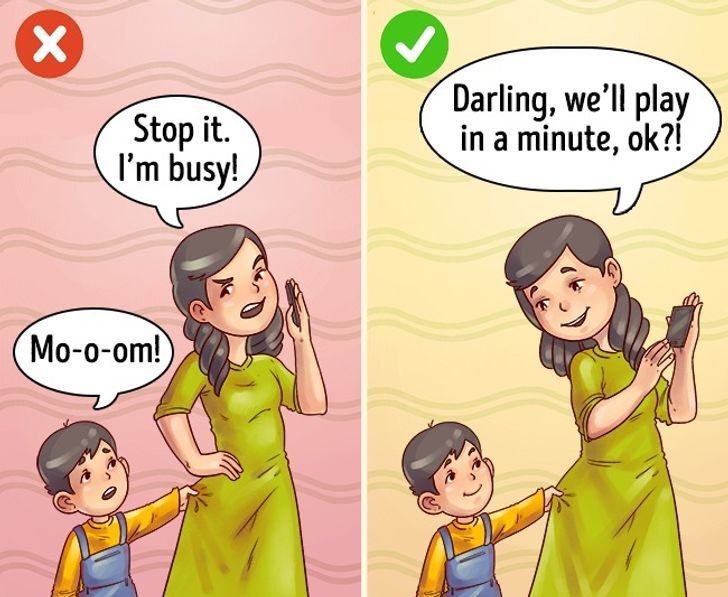
When a child does not listen, the first reaction of many parents is often anger or impatience. But what we sometimes forget is that adults’ emotions spread to children very quickly.
If adults react with anger, children can easily fall into a state of stress, fear, or resistance. In that moment, the conversation between parent and child can quickly turn into an emotional confrontation rather than an opportunity for the child to learn.
Ngược lại, khi người lớn giữ được sự bình tĩnh – nói chậm lại, hạ giọng xuống và phản ứng có suy nghĩ hơn lúc đó, trẻ cũng dễ dàng ổn định cảm xúc của mình. Chính sự bình tĩnh của người lớn là một cách rất tự nhiên để trẻ học được cách kiểm soát cảm xúc của chính mình.
Understand the reasons behind the behavior
A “disobedient” behavior rarely appears randomly. Behind it, there is often a reason that the child does not yet know how to express.
For example, a child may behave poorly because:
the child wants attention but does not yet know how to show it
the child does not fully understand the adult’s request
or simply because the child is tired, hungry, or emotionally overwhelmed
When adults focus only on stopping the wrong behavior without understanding the reason behind it, the problem may repeat many times.
In contrast, when parents understand what is causing the child to react that way, they can address the root of the problem instead of only dealing with the outward behavior.
Guide instead of only punishing
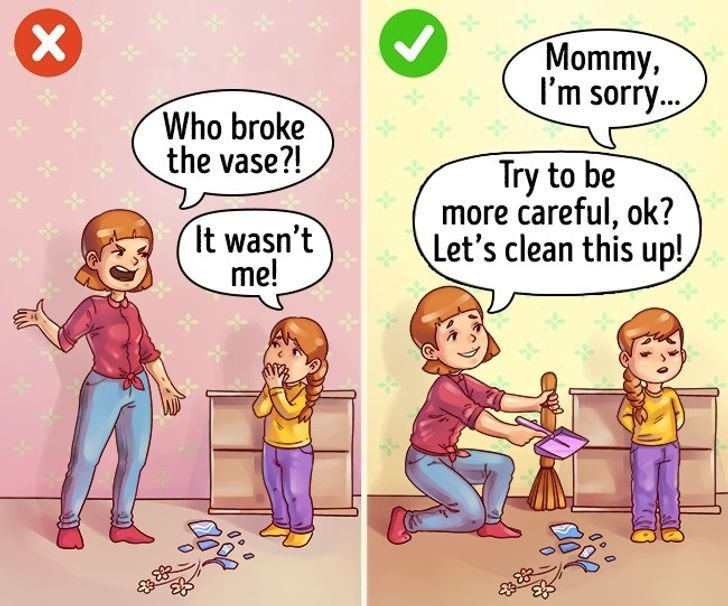
A common mistake in raising children is stopping at prohibiting the wrong behavior without showing the child what they should do instead.
For example, adults often say:
“Don’t do that.”
But for children, this statement is sometimes not enough. They may know that they should not do something, but they still do not know what the correct behavior should be.
Therefore, instead of stopping at prohibition, adults can give clearer guidance, such as:
“Việc này có thể gây nguy hiểm. Chúng ta thử làm theo cách này nhé.”
When children are given explanations and guidance, they not only stop the wrong behavior at that moment, but also learn a better way to act in the future.
conclusion
After everything, perhaps the most important thing adults need to remember is this: most children do not intentionally become difficult.
They are simply in the process of learning how to understand the world around them, how to interact with others, and how to manage emotions that are still very new to them. In that journey, making mistakes or behaving imperfectly is almost unavoidable.
If every time a child makes a mistake the first reaction from adults is scolding, the child may only learn to feel afraid or to resist. But when adults are a little more patient, slow down a little to listen and guide, children have the chance to understand and grow from their own mistakes.
Therefore, what children need most is not more criticism.
What they truly need are adults who are calm enough, patient enough, and understanding enough to walk beside them as they grow.
—————–
Linkachu – Someone who has battled weight for nearly 20 years and is currently exploring the “eat fully, still lose weight” method.
This is my Facebook! LinkachuMC


 English
  Vietnamese